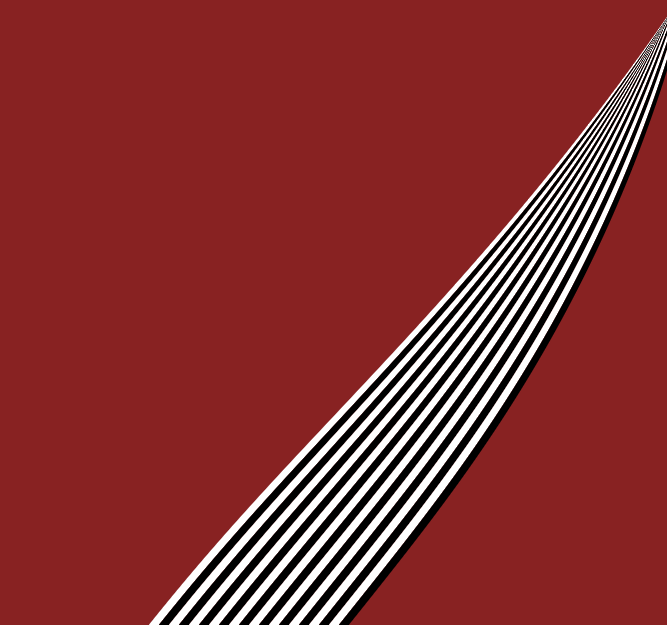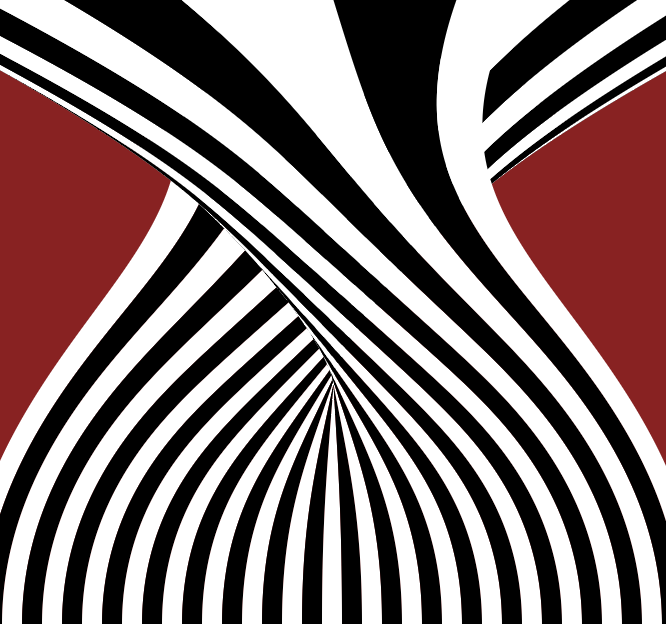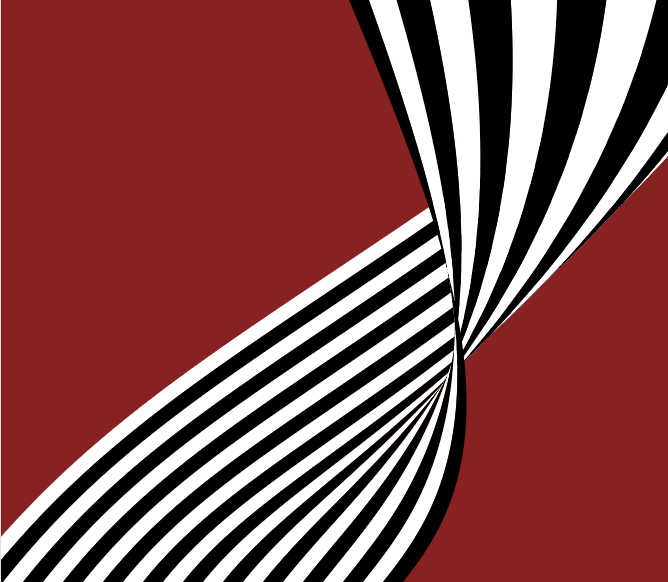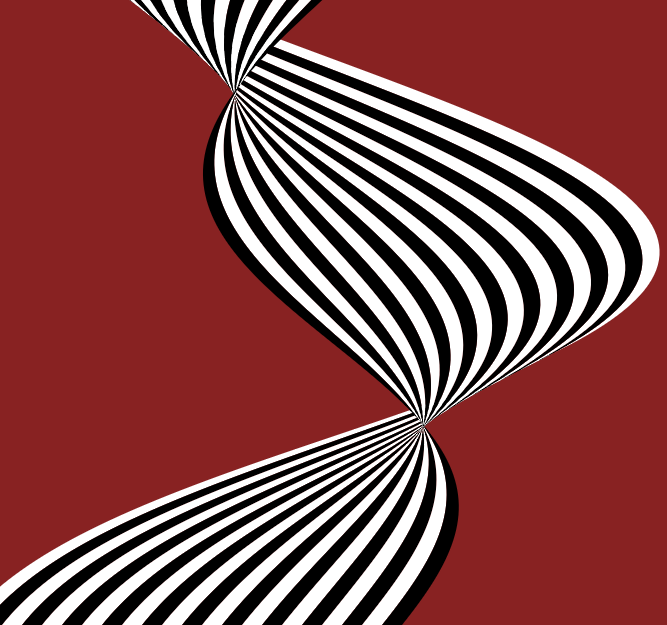
Double twist and wrap. Â While the last image was on the lackluster side, this one has everything turned up to 11. Â There is a strong deflection as the particles pass through the first peak and then they are swung back again as they exit the ring on the other side. Â An important thing to notice is that these are clearly defined and there is little mixing. Â If these equations were chaotic, then there would be mixing among the lines.
Archives for October 2012
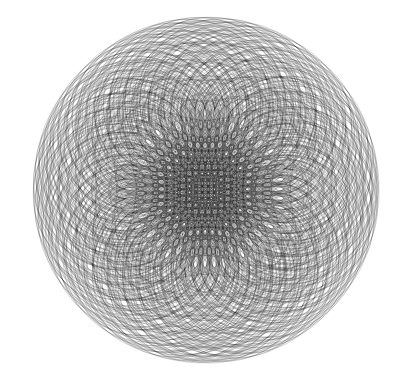
Bouncing Circle Grid
Twist #2
Simple twist
This shows the distortion in flow from a simple annular distortion. Â It’s part of a series that started with “distortion” and “a single twist and spray“
Related Images:
A single twist and spray
One of the most popular images I’ve developed (I’ve no idea what verb to stick here) is this basic geometric op art style piece. Â I was just using a very simple mask to test out using differential equations to generate families of curves. Â It’s grown on me, and I’m starting to put some more images together in a similar style. Â This is the first of what I hope is a very fruitful series.
The first images I generated used first order differential equations, which have the nice property that the curves never cross. Â However, it severely limits the shapes that can be produced as each point has one and only one direction through it. Â Bumping up to second order added multiple directions through a point as an option, and it turns out some of those crossings can end up looking pretty sharp.
Related Images:
Supercharged performance
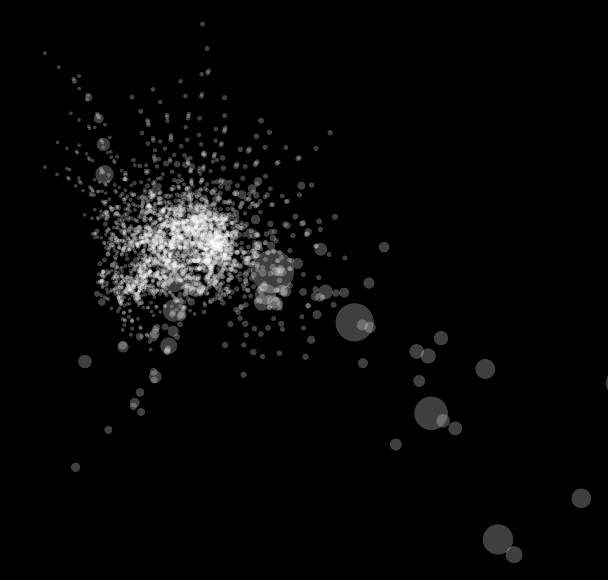
I was going back through some of my old posts and making sure the javascript still works, and I loaded up the three.js particle system test code I put up a while back. Instead of being broken, it was even faster in chrome than when i wrote it. I was surprised at how much of a difference the boost in performance made.
Related Images:
Grids of circles
Experimental generative images
These are all simple images where I’m testing out a very simple set of rules. I’m using a modified lorentzian function to generate the colors near each line. The position and intensity of each line is determined by a tree like algorithm. I got a lot of different effects from playing with the colors and the height of each line. Like many things in this learning process, I never thought some of these minor tweaks would have such a large impact on the resulting image. The parameters that I did expect to change things just ended up making things either too muddy, dense or too sparse. I’ve still got to give it some try with some real colors, but I’ve gotten sidetracked yet again!
Related Images:
All things must pass
This article reminded me of one of the strange features of the standard wave equation from basic physics. Â The wave equation describes an infinitely long vibrating string. Â Like point masses from Newtonian physics each bit of string has a position and velocity. Â If you know the position and velocity of the entire string at one moment of time, you can predict the position and momentum of any bit of string at any time in the past or present. Â It seems natural to think in those terms because we predict the motion of things around us all the time.

The reason this works is that the wave equation lets us solve for the time evolution of the system based on the current state.  For the case of a string, the time and position variables are symmetric, and knowing the position and velocity of the string at one point for all time is just as good as knowing about all space at one time.  Philosophically this is a nice feature.  It means that nothing in this world can escape you, all you have to do is sit in one place and everything either has passed you by or will pass you by, nothing can avoid you forever.
In higher dimensions things are similar, but just a little different. Â For a 3 dimensional space time (2 spacial dimensions and 1 time) knowing the position and velocity for all space at an instant of time is what you need to make predictions. Â Instead of sitting in 1 place and being able to keep track of everything, you need to monitor a single line that divides the world in half. Â Knowing everything that crosses that line for all time lets you know everything in that space. Â In our 3 dimensional spacial world, you have to monitor an entire infinite plane.
That works because signals on this string travel in one direction with one speed, they never turn around or stop.  That is completely unlike particle dynamics where things move independently.  This would be just an interesting feature of these wave equations, but basic quantum mechanics  is a wave theory, and the same rules apply.