Curvature of the Mind

Thoughts from a Recreational Physicist

Archives for November 2012

Generative Convergence #2 – Ghosts

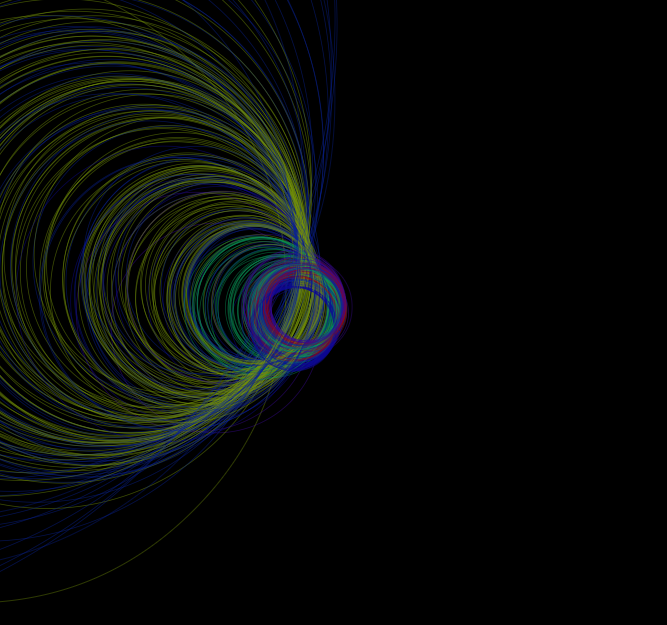
This is a companion to the last image, the Dirac Delta Function is moved over to the right and some of the intensity parameters have been punched up a little.  These are really starting to resemble the transition energies from atomic orbitals.  I’m still on track to add another level of complexity before I start messing with the colors, even though I’m going way far away from my initial goal of trying to replicate a thick paint stroke.

Related Images:

Generative convergence #1 – Shadows

I wasn’t aiming for something this sparse, or this kind of vertical pattern, but it turned out like a more refined version of some of my other experiments.  This method is interpolating a function that resembles a Dirac delta function centered at 1/2, the other lines are reflections of that central spike.

Related Images:

More one dimensional generative experiments


These are some more images I’ve created on my way to generating a realistic brush stroke.  Given how much I’m liking these, and some more experiments that I’m cooking up, I’m not sure if I’ll ever get to the brush strokes.

Related Images:

New Technique – Iterated function system interpolation functions

I’m working on a technique to create heavy textured straight brush strokes.  There are a number of abstract paintings using textures I’d like to reproduce.  I’m definitely a way off, but I’m liking some of the results so far.

What separates these from the fractals I’ve generated in the past is that they have a one dimensional linear component, and a single valued transverse component.  Previously the fractals have all been 2 dimensional with more complicated structures, which would be multi-valued.

A big advantage of this is that I only have to compute one value per point and don’t have to use any alpha values.  Here are some of the initial experiments.


The goal was to produce a rough edge as the “brush” lifted off, but I’m liking a bit of the texture on the most intense part of the “stroke”

Related Images:

This is what additivity gets you

These are all variations on some of my earlier vector field renderings.  These take two different vector fields and show render paths for various sums of the vector fields.  There isn’t anything really surprising in the images, but they are attractive nonetheless.


Related Images:

All filled in – Animated Generative circles #2

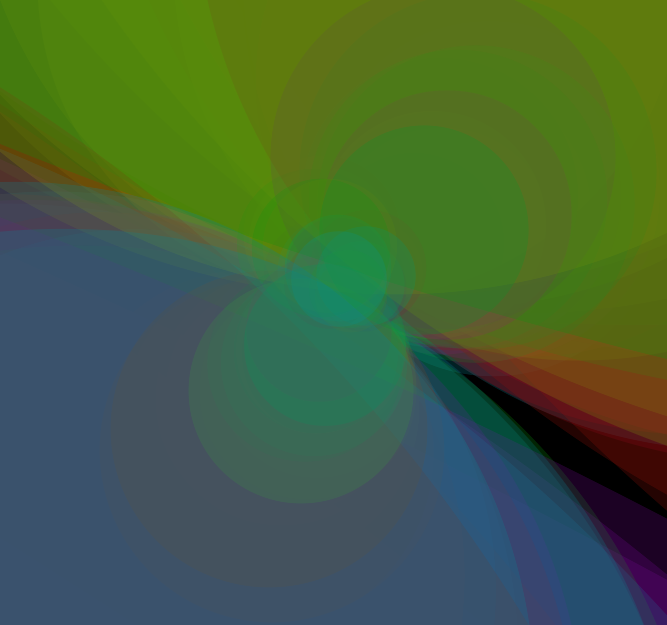
The stills don’t have anywhere near the punch that the ring rendering does, but the nebulous billowy cloud like effect is nice. I’m using the same code to pick the colors, just replacing stroke with fill. I’ll have to keep this in my back pocket and see if there is something I can pull this out for in the future.

Related Images:

Technique work

I can’t say I’m a huge fan of these, but I’m playing around with colors and the rendering.  Right now they just seem pretty  for pretty’s sake.  I think I’m waiting around for inspiration on how to put these to good use.  These are generative and then just selected to save as an image.  Enjoy!


Related Images:

Another generative geometric fractal experiment

I’ve got to take a break from the stripey stuff for a little while.  This is circling back to the circles.  I’ve taken the mapping I’ve been using from the inside of a sphere to the set of all circles, lines and points on the plane and combined them.  This is what I was aiming for from the outset of this experiment, I’ve just taken a few detours getting here.  I’m still trying to figure out if I can use these images or the best techniques to render the objects, or even which sets of transformations even work well for these images.

The core of the approach is tying back the relationships between fractals and parameter spaces.  Given the mapping from a subset of 3 dimensional space to simple geometric objects on the plane, we can use that to map distributions of points on that subset to distributions on the simple geometric objects of the plane.  I’m trying to figure out if I can make anything pretty with that, and can I exploit it to make anything meaningful out of those images.  So here is a random walk through these spaces.

Related Images:

Ring around

This is another shot from the quantum superposition viewer.  It’s neat as op art, but I’m still trying to fully grasp the realization I made that this represents an unchanging distribution of a unit of rotational motion.  The state is fixed, but it contains within it an orbiting particle.

Related Images:

Current project

I’m playing around with quantum mechanical superposition and hydrogen wave functions again.  This time with really simple 2 dimensional renderings.  I’ve been trying to get a grip on some of the basic principles and this is what I’ve got up so far.

I’m learning a lot, and there is quite a bit to be gained from playing around with something as simple as this.  My end goal for this is to bring back some of the simple demos from the genesis of this blog, and build more of a directed walk through of some of the principles and features of the system.  Up to this point, the demos have left it completely up to the user to figure out what to do with them.  Ideally I’d like it to be so inviting and obvious that viewers just give it a go, but that’s probably too ambitious for the topics.

At work I strive to build systems that leave the simple stuff simple and make the complicated stuff manageable.  Trying to eliminate the complexity from something that is naturally complicated is just going to end up covering it up and frustrating the user.

Related Images:

Next Page »