Curvature of the Mind

Thoughts from a Recreational Physicist

New Feature – Download demo image

Atomic Orbitals demo imageI’ve been revamping the site, working towards a more visual layout.  Part of that has been going through old posts and attaching an image to every single one of them.  Some of them just needed selecting an image from the content, and some needed an entirely new image generated from the demo code.  In the past, that has meant capturing screenshots or uploading the image to a service like imgur.

I figured there has got to be a better way, so with a little bit of simple research, and adding some angularjs to the site, I’ve added a helpful download button to many of the javascript demos on the site.  This includes the 3D Harmonic oscillator demo, and the Atomic Orbital demo as well.

While that makes things easier for me, it also makes the site much more useful in general. Now you can pick out an orientation for an atomic orbital and snap a quick shot of it however you want.  Or you can build your own fractal and grab a copy of it.

I’ve also gone through the old catalog and updated pages making sure they all still work.  A number of those early projects were one off simple demos.  While neat, I don’t think they’ve lived up to their full potential because of the limits in parameterizing them and putting multiple copies on a single page.  Now that I’m rewriting them using angularjs I’ll be able to integrate them much more richly into my writing.

I’m jonesing to take full advantage of much of the code I’ve written.  I’ve only done two basic posts based on a javascript based geodesic solver I’ve written for Schwarzschild black holes.  There is so much more I can do with that.  I haven’t touched on the Doppler effect in the speed of sound demo, or added relativistic effects.

Related Images:

More crossing lines images.

crossing lines modulo

I haven’t had much time to play with the crossing lines. I do like their simplicity and the way they can create complex crossing relationships. I’ll be playing around with braids next, and integrating differential equations and chaos of course.

Related Images:

Roiling sparks

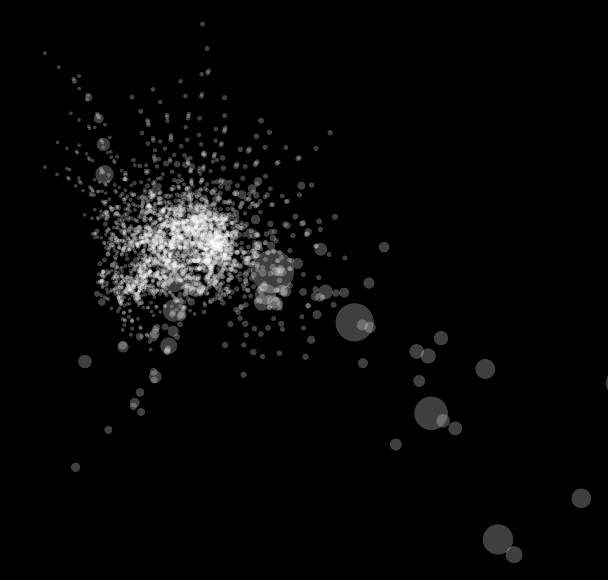
dots nice effectContinuing on with experimenting with grids of circles.  I’ve cranked up the randomness, the alpha channel and the circle size on this one.  It works really well with some animation.  I might consider this technique to add some interest to the quantum mechanics demos to draw the eye to the density functions.


Related Images:

Experimenting with pixel sizes

Playing around with grids of colored dots

Playing around with grids of colored dots

I’d been rather unmotivated with a number of projects that I’m working on, but going through my inspiration board on pinterest got me fired up again.  I’ve got a few more experiments on the way.

Related Images:

All filled in – Animated Generative circles #2

The stills don’t have anywhere near the punch that the ring rendering does, but the nebulous billowy cloud like effect is nice. I’m using the same code to pick the colors, just replacing stroke with fill. I’ll have to keep this in my back pocket and see if there is something I can pull this out for in the future.

Related Images:

My First canvas experiment

This is my first experiment with canvas. I was trying to build a better understanding of the geometric uses of Clifford algebras. This little snip-it shows some features of the Clifford triple product in 2 dimensional Euclidean space.

Related Images:

Twist again – more geometric generative op art

After fighting all the overlapping issues with second order equations, I switched back to first order and hard coded a single focus point in the equations.  With that change I was able to start doing some more predictable plots with the ring functions.

Related Images:

Circling back to a dead end.

These renderings never really went anywhere. They show chaotic orbits around 3 fixed attractive potentials while varying a uniform magnetic field. There are some lovely sweeps and folds as the chaos unfolds. I also like the glowing effect as the orbits get tightly wrapped around the centers of attraction. There wasn’t much to this other than some pretty curves, however, I did realize how essential drag is in making interesting forms. I suppose adding flocking and some higher order terms would help in adding further visual interest.

Related Images:

Bouncing Circle Grid

I’m pleased with the motion on this one.  It’s still just experimentation, but the results are promising.

Related Images:

Supercharged performance

I was going back through some of my old posts and making sure the javascript still works, and I loaded up the three.js particle system test code I put up a while back. Instead of being broken, it was even faster in chrome than when i wrote it. I was surprised at how much of a difference the boost in performance made.

Related Images:

Next Page »