Atomic Orbitals
Real-time 3D plots of the hydrogen atom’s electron orbitals, ray-marched in a WebGL fragment shader. Pick an orbital by its quantum numbers, choose how to project the wavefunction onto the screen, and drag the cloud around to explore its structure — the notes below the controls explain what each number and mode means.
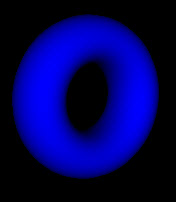
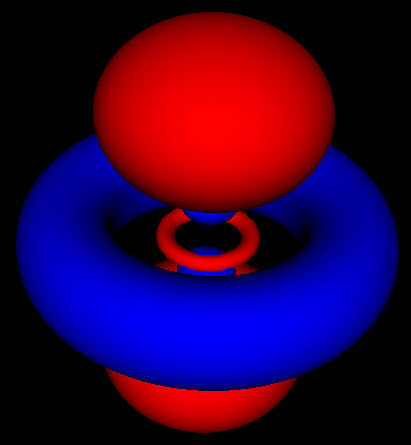
The two historic renders: the translucent cloud that ray-sums the probability density along every line of sight, and the solid surface that thresholds it — the two faces of the same wavefunction.
Where the electron is
Squash the 3D cloud onto its radial coordinate and the shells appear. This widget plots the radial probability of hydrogen’s eigenstates against two classical answers — the dwell time of a Kepler orbit, and what relativity does to it.
The shapes are polynomials
The angular part of every orbital — the thing that makes an s a sphere, a p a dumbbell, a d a cloverleaf — is a homogeneous polynomial of degree ℓ that the Laplacian kills. This widget counts them: of the (ℓ+1)(ℓ+2)/2 monomials of degree ℓ, exactly 2ℓ+1 survive as the shapes of the subshell.