Curvature of the Mind

Thoughts from a Recreational Physicist

Complexification

This is one of the sites that got me back into blogging.
Complexification

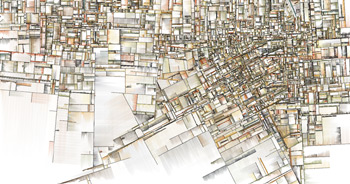
I’ve been trying to put my finger on what I really enjoy about this collection. To start with, the drawing algorithm used throughout the site is extremely pleasing and has a real organic feel to it. The peaceful and relaxing palette doesn’t hurt either.

The first few images really stand out and look meticulously hand drawn. As I go back and look through the site, I am continually amazed at the differences in the different series and how well they are drawn together through the artist’s brush.

While the pictures themselves are beautiful, I love that the algorithms are public as well, and that these images are all algorithmically generated. It’s neat to see things like sorting algorithms visually represented, but even more beautiful when the code expresses it’s inner beauty through a canvas.

Related Images:

The most basic IFS Fractal of all – the cantor set

cantor set

The cantor set is the simplest IFS fractal out there

What is that, Morse code? That my friends is the cantor set. It is one of the examples of basic topology and one of the objects that highlight many of the non-intuitive aspects of infinities.

The most common construction is to take a line and remove the middle third. Next you remove the middle thirds of the two remaining segments. You keep removing the middles of every segment that is left. If you could continue for ever, you would be left with an infinite “dust” of disconnected points.

We can build one with two simple transforms. Just contract by 2/3rds at two different points and the attractor is a cantor set. The next images are going to be simple tweaks of the cantor set, and the fractal space will grow from there.

Related Images:

Visual complexity

Visual complexity is a bad ass site. It introduced me to the term generative art and reawakened my interest in exploring it myself. I fell in love with the mathematics and images of fractals that exploded in the eighties. One of my favorite books in high school was chaos by James Gleick. The pictures were beautiful, and the math to compute them could be grasped by someone with just a high school education.

I eventually tired of the images and wrote the whole thing off as I realized that most of the slick pictures were little more than thomas kincaid paintings for geeks. They looked pretty, but lacked message or meaning. I still played around with this stuff from time to time, but it was just a personal hobby of mine.

When I stumbled onto visual complexity things changed. Here were images and programs that just dripped and oozed with meaning and message. Here were artists that distilled meaning out of data and poured it onto the page, so that every inch of the screen illustrated their point. They pull the narrative out of the noise and instead of telling it with words and numbers, they distill it down to raw pixels so it leaps out at you with a glance. That is what I aspire to.

So poke around the site a little bit, there is a ton there and I plan on linking to some of the ones that have really inspired me, and others that are just plain cool.

Related Images:

« Previous Page