After fighting all the overlapping issues with second order equations, I switched back to first order and hard coded a single focus point in the equations. Â With that change I was able to start doing some more predictable plots with the ring functions.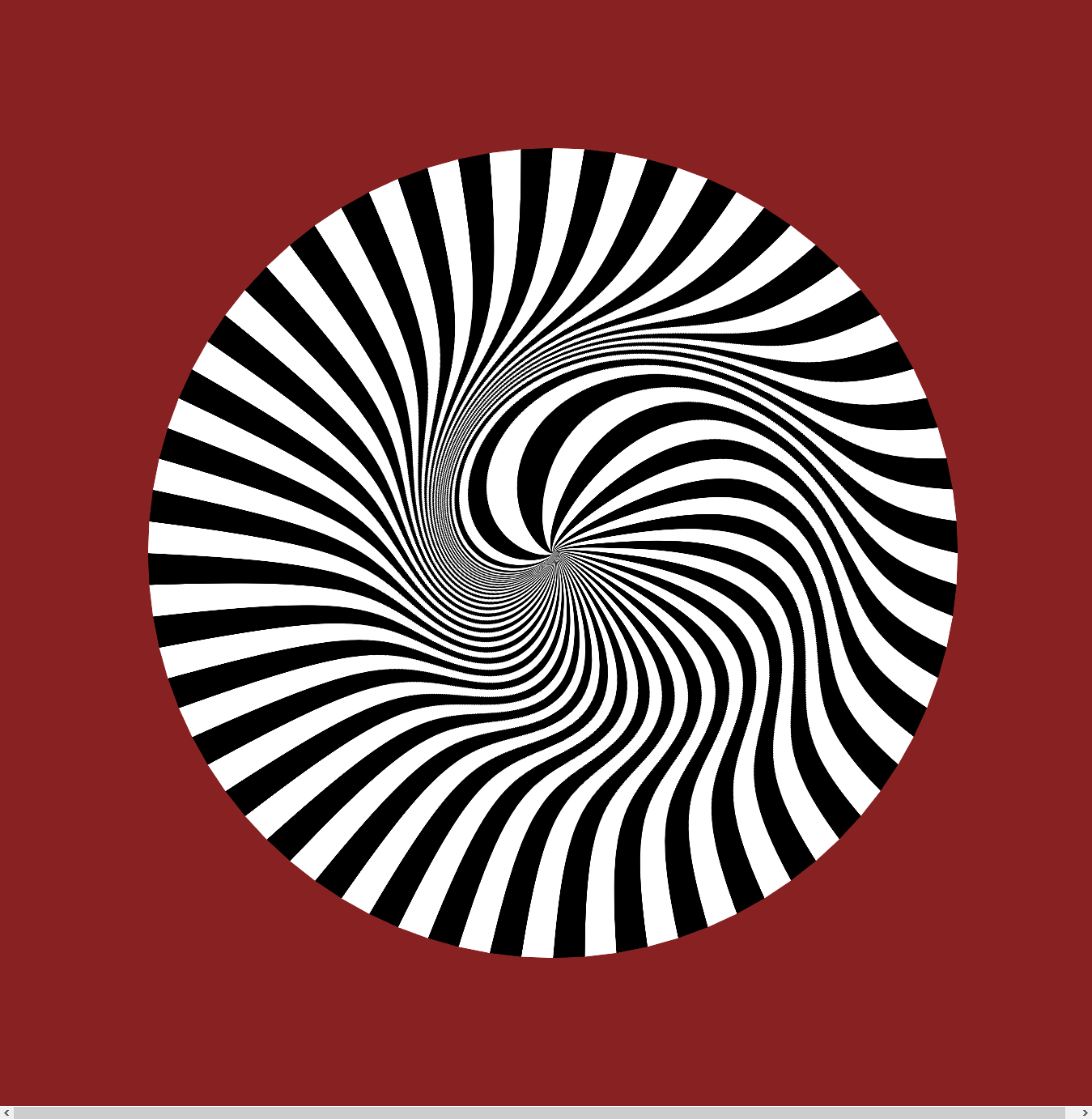
Askew Op Art Disk – Where’d the symmetry go?
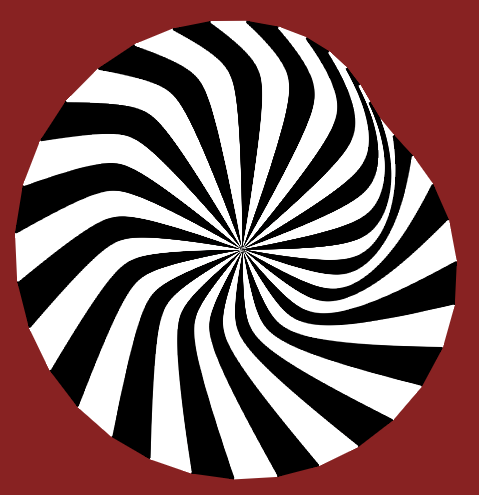
The same equations were used to generate this image as well.  The only difference is the starting point.  Instead of expanding from the center of the distortion field, the starting point is displaced a little bit towards the bottom.  This highlights a number of different things. First while the equations are symmetric, the resulting image is decidedly asymmetric.  If you follow the lines to the right vs. the ones to the left, you can see that the paths have decidedly different curves.
Related Images:
Circling back to a dead end.
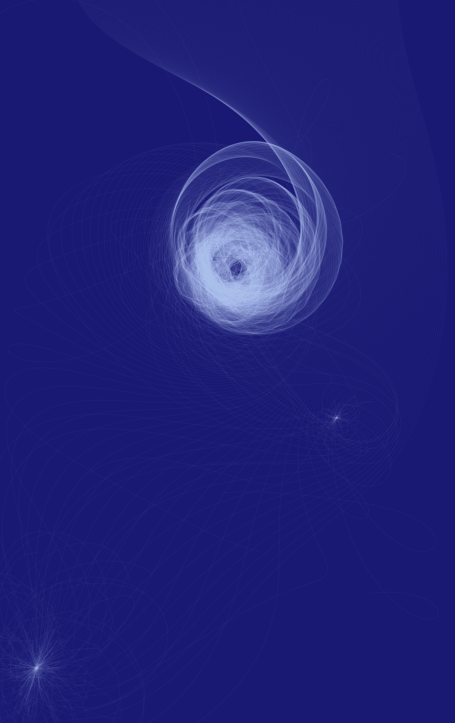
These renderings never really went anywhere. They show chaotic orbits around 3 fixed attractive potentials while varying a uniform magnetic field. There are some lovely sweeps and folds as the chaos unfolds. I also like the glowing effect as the orbits get tightly wrapped around the centers of attraction. There wasn’t much to this other than some pretty curves, however, I did realize how essential drag is in making interesting forms. I suppose adding flocking and some higher order terms would help in adding further visual interest.



Related Images:
Spider web fractal
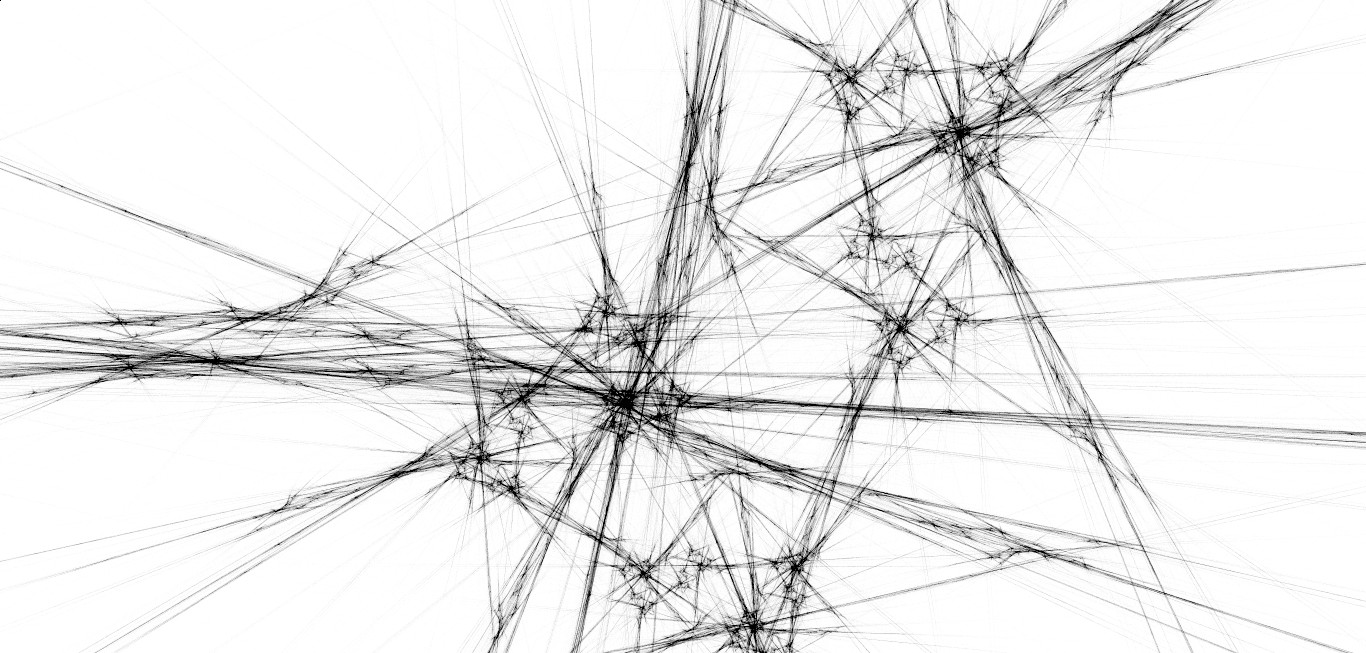
It’s a little late for Halloween, but spooky nonetheless.
Related Images:
Simple Op Art disk
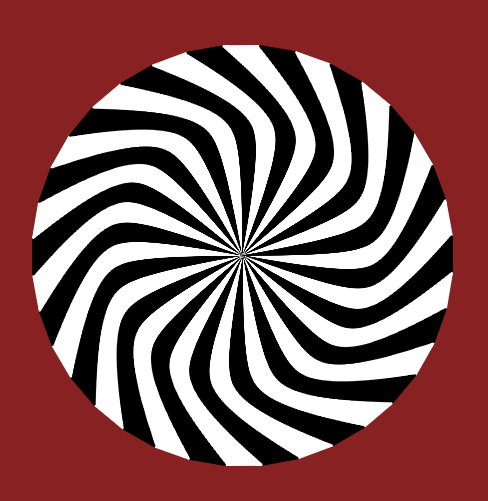
This is what you get if you take the parallel stream from the rest of the series and replace them with a circular spray from the center of the distortion. Â Everything gets bent uniformly when it hits the ring. Â Moving to second order equations gives you the freedom to have multiple directions from a single point like this without a singularity.
Related Images:
Twist #3
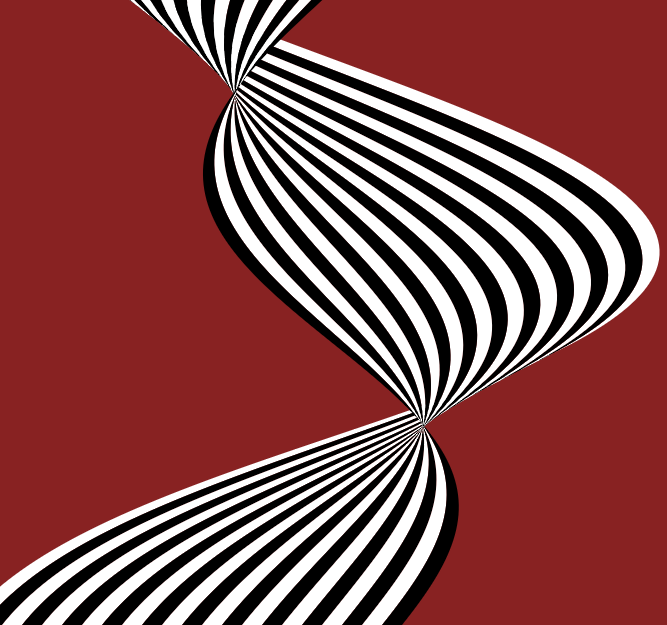
Double twist and wrap. Â While the last image was on the lackluster side, this one has everything turned up to 11. Â There is a strong deflection as the particles pass through the first peak and then they are swung back again as they exit the ring on the other side. Â An important thing to notice is that these are clearly defined and there is little mixing. Â If these equations were chaotic, then there would be mixing among the lines.
Related Images:
Twist #2
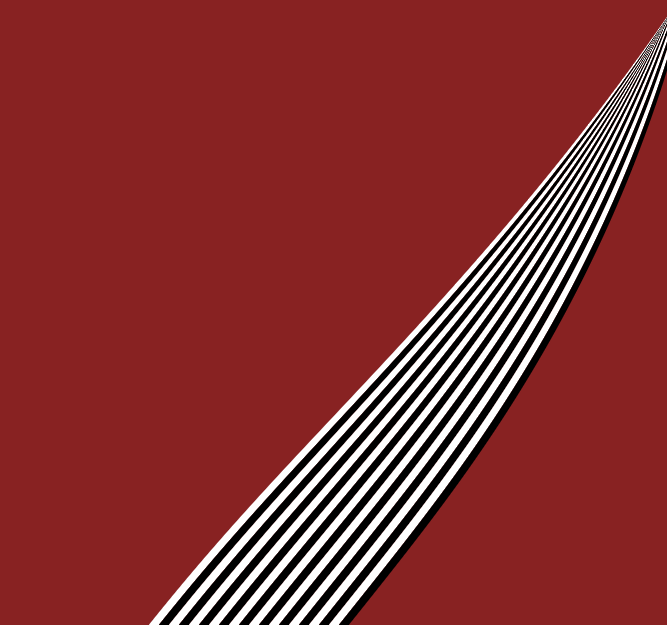
While this isn’t as dramatic as some of the other images, it shows what happens as either the velocity of the particles increases or the strength of the distortion diminishes. Â Instead of dramatic changes, things just tighten up a little bit and bend.
Related Images:
Simple twist
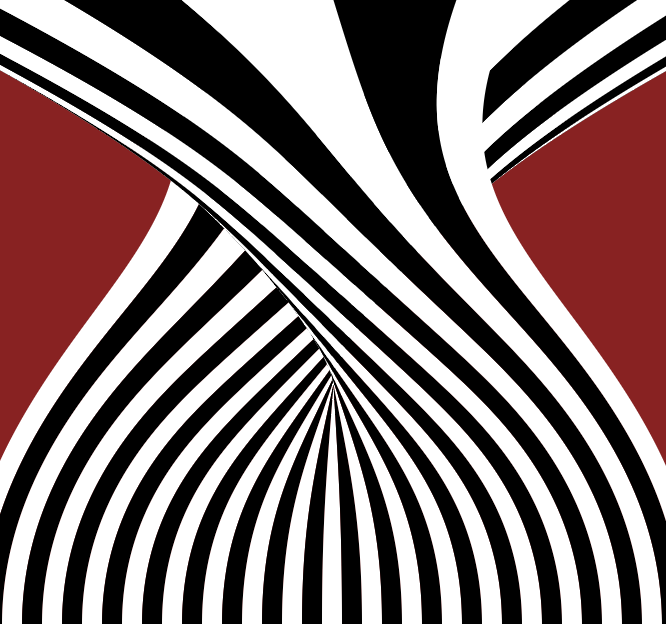
This shows the distortion in flow from a simple annular distortion. Â It’s part of a series that started with “distortion” and “a single twist and spray“
Related Images:
A single twist and spray
One of the most popular images I’ve developed (I’ve no idea what verb to stick here) is this basic geometric op art style piece. Â I was just using a very simple mask to test out using differential equations to generate families of curves. Â It’s grown on me, and I’m starting to put some more images together in a similar style. Â This is the first of what I hope is a very fruitful series.
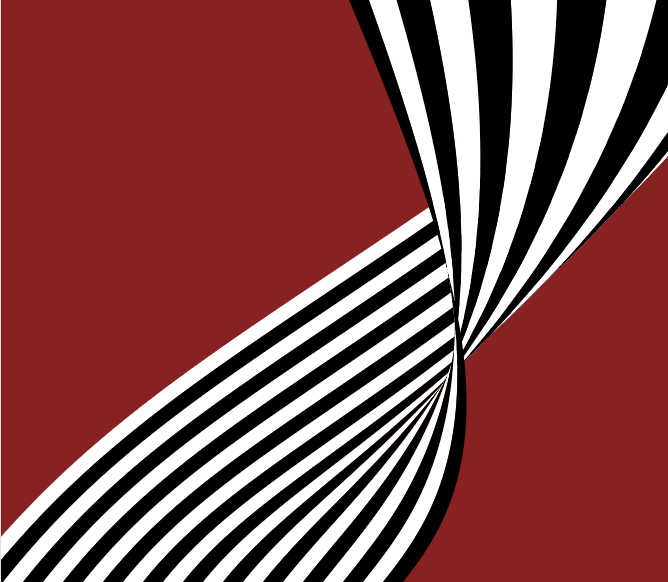
A single twist and spray
The first images I generated used first order differential equations, which have the nice property that the curves never cross. Â However, it severely limits the shapes that can be produced as each point has one and only one direction through it. Â Bumping up to second order added multiple directions through a point as an option, and it turns out some of those crossings can end up looking pretty sharp.
Related Images:
Experimental generative images
These are all simple images where I’m testing out a very simple set of rules. I’m using a modified lorentzian function to generate the colors near each line. The position and intensity of each line is determined by a tree like algorithm. I got a lot of different effects from playing with the colors and the height of each line. Like many things in this learning process, I never thought some of these minor tweaks would have such a large impact on the resulting image. The parameters that I did expect to change things just ended up making things either too muddy, dense or too sparse. I’ve still got to give it some try with some real colors, but I’ve gotten sidetracked yet again!


