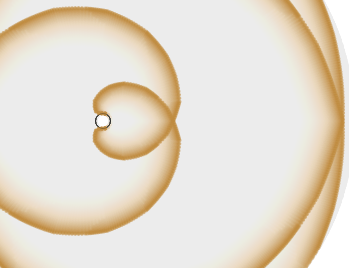
Continuing on the theme of central forces. This is an initial image of the next guy I’m looking at.

This one is pretty similar to the others I’ve done except for that empty circle in the center.

Thoughts from a Recreational Physicist
Continuing on the theme of central forces. This is an initial image of the next guy I’m looking at.
This one is pretty similar to the others I’ve done except for that empty circle in the center.
This time I mapped the pendulum angle and time onto the surface of a cone to create a tunnel effect. For the parameter space I’m looking at, you can really see how the paths will converge for a while and then suddenly diverge wildly.

This next demo highlights the butterfly effect. These curves show the same pendulum as before, this version has the time axis wrapped around the center of the screen and the exponential of the angle as the radius. All the pendulums start at a very similar initial position and for some driving functions they diverge wildly and others they all stay pretty close.


This time I’m not taking up all of the screen. Still working with polynomials and trigonometric functions.
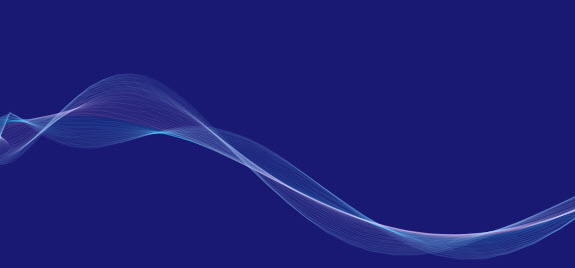
 I just like this one!
I’ve had this sitting on my computer for a while and thought I’d publish it rather then just leave it sitting there. This simulates a pulse of light expanding out like my compression wave examples. This time however, we are looking at a pulse of light expanding in the vicinity of a black hole. Rather than expanding out in a circular wave pulse, it wraps around the hole and circles back to the original location traveling around the hole forever.
I’m still trying to wrap my head around what this implies. Most General Relativity texts cover light cones tipping over at various distances from the black hole, and particular light paths including distances where light orbits the hole. The code is pretty rough and ugly right now, but is a fun little application of solving differential equations in javascript.

This is something that I just stumbled onto while working on something else. I’ve taken a quick break from the atomic orbital viewer. I’m trying to make the IFS fractals more visually interesting. One approach is to create Mandelbrot versions of the IFS fractals which should break up the uniformity. Instead of showing one image that is an exact copy of parts of itself, each part of it would be locally similar to a different fractal. The images I’ve been creating up until this point have all been analogs of Julia sets. I’m hoping the Mandelbrot versions will turn out more interesting. It also opens up the potential of higher dimension renderings as Mandelbrot sets exist in parameter space, not the actual fractal space.
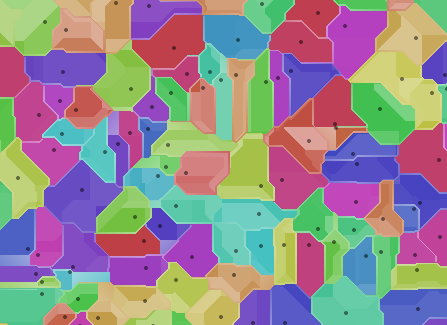
In order to do that, I need to estimate the “basin of attraction” for each mapping in the fractal. A voronoi diagram is one way to do that. I started out just generating standard simple diagrams as a test. Sometimes images are just the best way to see what is going on. Using a very simple algorithm, I just iterated through a list of random points and colored pixels based on the closest one. That meant I kept track of the minimum distance and the matching index. Which lead to renders of that distance, followed by the sine of the distance.

Now that I’m looking at alternate renderings, I figured the easiest way to find the borders of domains was to track the second closest point as well and whenever the distances between first and second point were equal you were on a boundary. That looked ok, but lead to some artifacts.
Now that I was collecting this info, I figured I’d try to do something else with it, so I applied it to the alpha channel and switched over to the taxicab metric just for fun.


I like the idea of putting demos up directly on the blog like the last one. However, they don’t show up on feed readers so you either get the text without the image and then click through. I can throw down some javascript to include a place holder link to the demo in the feed, or do excerpts, which I really don’t like, or go back to the old format of talking about something and linking to it at the end, which I don’t really like either.
Does anyone have any ideas or suggestions on how they handle this issue?